Devon Vogel · 23 September 2026
Corporate Emission Strategies Reshape Funding Landscapes for Quantum and Perovskite Research
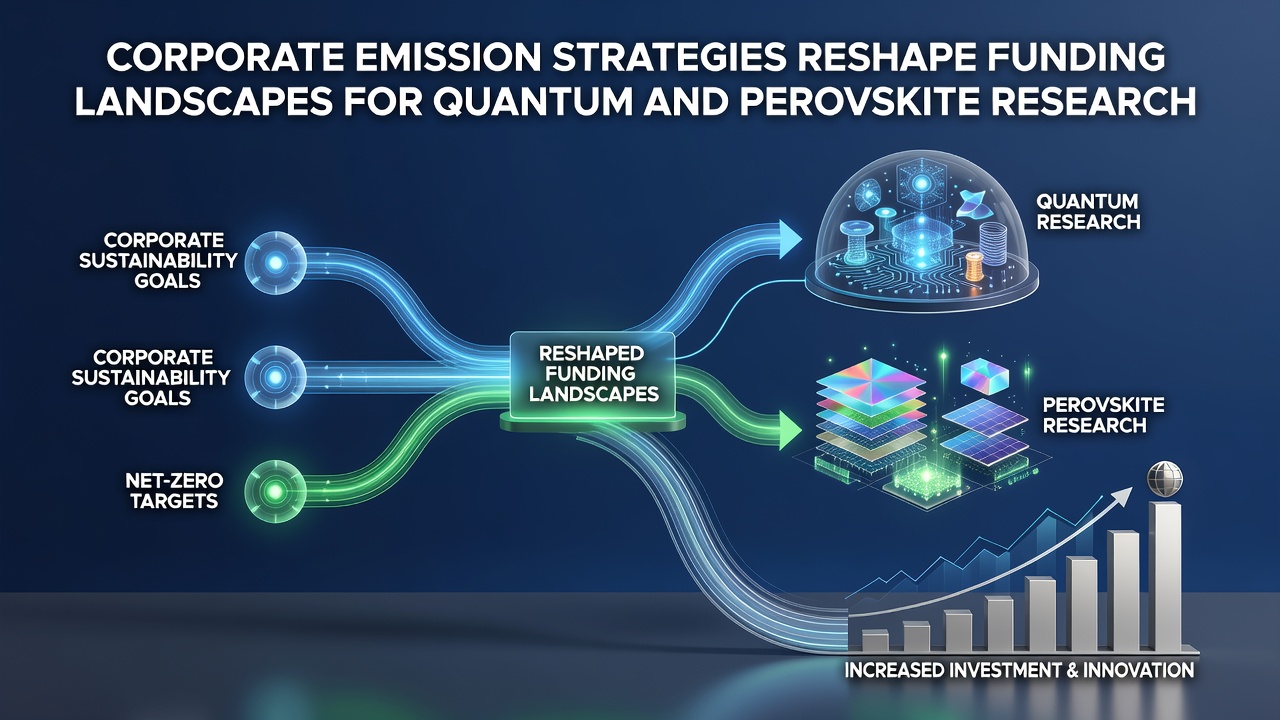
Corporate emission reduction commitments have accelerated since the early 2020s, and by September 2026 data from multiple industry trackers showed that thousands of firms across Europe, North America, and Asia had aligned capital allocation with net-zero targets. These strategies often prioritize technologies that deliver measurable decarbonization, which has redirected substantial portions of research budgets toward quantum computing and perovskite materials because both fields promise efficiency gains in energy systems and computational modeling of climate scenarios.
Corporate Emission Frameworks and Technology Prioritization
Many multinational corporations adopted science-based targets that require annual reductions in Scope 1, 2, and 3 emissions, and those targets frequently include provisions for funding external innovation that can scale clean solutions. Research indicates that companies meeting interim 2025 milestones allocated an average of 12 percent of their innovation spend to advanced materials and computing platforms capable of optimizing renewable grids or simulating molecular interactions for low-carbon chemistry. Quantum systems excel at handling complex optimization problems that classical computers struggle with, while perovskite solar cells offer potential efficiency levels above 30 percent in tandem configurations, making both areas attractive for firms seeking verifiable emission offsets.
Quantum Research Funding Trends
Funding for quantum initiatives tied to emission strategies grew steadily through 2025 and into 2026, according to reports from government agencies in the United States and the European Union. The U.S. Department of Energy expanded its quantum information science centers with additional corporate co-funding streams focused on energy-grid modeling, while the European Commission’s Horizon Europe program earmarked resources for quantum algorithms that support carbon capture optimization. Observers note that corporations in the automotive and logistics sectors provided the largest private contributions because quantum-enhanced route planning and materials discovery directly support their Scope 3 reduction pledges.
One consortium led by a major European energy utility partnered with academic labs to apply quantum machine learning to wind-farm output forecasting, and the resulting models reduced curtailment losses by 8 percent in pilot regions. Such measurable outcomes have encouraged additional firms to structure similar grants, often requiring quarterly emission-impact reporting as a condition of continued support.
Perovskite Advancements and Investment Shifts
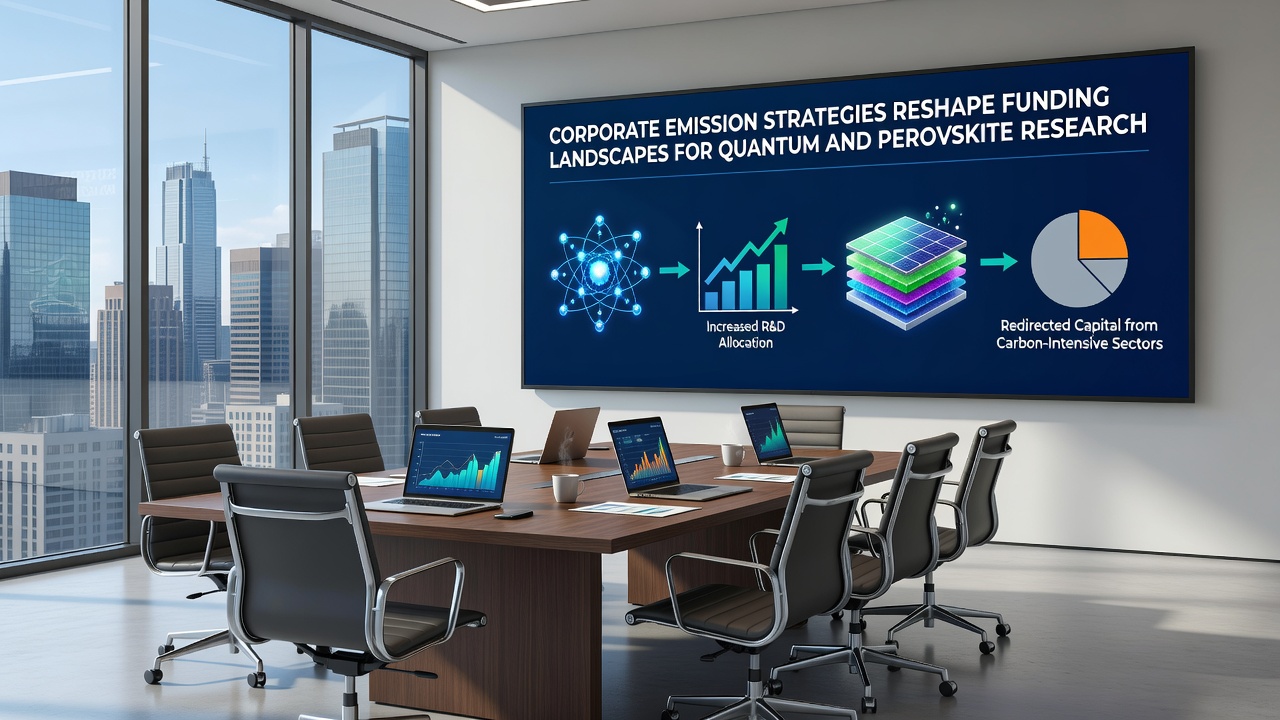
Perovskite research received parallel attention because corporate sustainability reports increasingly cite photovoltaic innovation as a direct lever for reducing reliance on fossil fuels. Data compiled by the International Energy Agency shows that corporate venture arms directed roughly 1.4 billion euros into perovskite startups between 2024 and mid-2026, with emphasis on stability improvements and lead-free formulations. Australian research institutions documented tandem perovskite-silicon cells achieving 32 percent efficiency in laboratory settings, and several Asian manufacturers secured multi-year supply agreements with electronics companies that had committed to 100 percent renewable manufacturing by 2030.
Those agreements typically include milestone payments tied to verified reductions in embodied carbon of the final solar modules. Researchers at Canadian universities found that scaling roll-to-roll printing processes for perovskites could lower production emissions by 40 percent compared with traditional silicon wafer methods, further aligning the technology with corporate emission accounting frameworks.
Geographic Distribution of New Capital Flows
European firms accounted for the largest share of announced quantum-perovskite crossovers in 2026, yet North American and Australian entities also expanded commitments. The UK’s innovation agency published figures showing a 27 percent year-over-year increase in collaborative grants that pair quantum computing groups with perovskite materials scientists. Canadian federal programs similarly linked clean-technology tax credits to projects demonstrating both emission reductions and computational advances. Observers tracking these flows point out that the common thread remains corporate demand for auditable progress toward net-zero targets rather than speculative technology bets.
Challenges in Aligning Research Timelines with Corporate Goals
Despite the influx of capital, mismatches between corporate reporting cycles and fundamental research timelines persist. Quantum error-correction milestones and perovskite stability benchmarks often require five to seven years of iterative testing, whereas many corporate sustainability officers operate under three-year key-performance-indicator windows. Research organizations have responded by structuring phased deliverables that include interim modeling results or small-scale device prototypes capable of showing incremental emission benefits. Industry analysts note that such staging has helped maintain funding continuity even when full commercialization remains distant.
Conclusion
Corporate emission strategies continue to influence the allocation of research capital toward quantum computing and perovskite technologies because both domains offer pathways to quantifiable decarbonization. Government statistics through September 2026 confirm rising co-investment levels, while academic and industrial partnerships increasingly tie deliverables to verified emission outcomes. The pattern suggests that future funding decisions will remain anchored in measurable environmental performance rather than technology novelty alone.